How to Cross the Finish Line on Top
2024 has turned into a surprisingly consequential year for my running.
I ran my first half marathon. Then another. Then another. I broke four miles in Orangetheory’s Catch Me If You Can benchmark, finished on the podium at my first trail half marathon, and somehow lowered my mile PR to 4:38.
There are worse problems to have than too many good races to write about.
I originally wanted to document every detail of every one of them. But memories don’t necessarily become more meaningful just because every detail survives. Sometimes the better record is the shorter one: what happened, what stayed with you, and what you learned before moving on to the next starting line.
So, here are a few finish lines from the year.
Learning the Half Marathon
I ran my first half marathon on April 21 in Reston, Virginia, finishing in roughly 1:37.
It was also my introduction to an important principle of distance running:
Hills are evil.
The course had plenty of them.
I’d run 13.1 miles before in training, but racing the distance felt different. A half marathon is long enough to punish early mistakes and short enough to tempt you into making them anyway.
It also introduced me to the surprisingly complicated art of drinking from an aid station while continuing to run.
My early technique consisted primarily of:
- grabbing a cup,
- spilling part of it on myself,
- attempting to swallow the remainder without drowning.
There has been improvement since.
The race also taught me something I’ve carried into almost every half since: the first few miles can lie to you.
When everything feels easy, running substantially faster seems perfectly reasonable. Several miles later, your body may submit a formal objection.
I would relearn that lesson in Connecticut.
Connecticut
My second half marathon took me to New London for the Ocean Beach/John & Jessie Kelley Half Marathon.
I had recently bought a red Tesla Model 3, and Connecticut became its first proper road trip. The drive north was long enough to teach me a few things about EV road trips, charging stops, and just how much longer a six-hour trip can become once reality gets involved.
We made a larger trip out of it and explored parts of Connecticut and New England before and after the race.
But race morning was the important part.
The Kelley Half started at Ocean Beach Park in New London on August 3.
Unlike my first half, much of the course was relatively flat.
Unfortunately, August had brought another opponent: heat.
As the morning progressed, the sun became increasingly difficult to ignore. Volunteers sprayed runners with hoses along portions of the course, and I became a very willing participant.
Aid stations became increasingly important too. At some point I discovered a technique other runners had already mastered: take a water bottle, drink what you need, dump some over your head, and move on.
Civilization advances through accumulated knowledge.
My larger problem was pacing.
I started aggressively and held something near my 10K pace much longer than I probably should have. It felt excellent.
Until it didn’t.
Somewhere after the halfway point, the bill arrived.
The second half turned into an increasingly stubborn argument between what I wanted my legs to do and what they were interested in doing. I slowed substantially and briefly walked more than once.
Eventually, though, the finish line appeared.
That tends to restore one’s enthusiasm.
I found enough left for a final kick and crossed in just under 1:32, a new personal best by several minutes.
Not the cleanest race I’ve ever run.
Still one of the most educational.
And Connecticut became another state checked off the list.
Four Miles
One of my favorite Orangetheory benchmarks is Catch Me If You Can, a 22-minute treadmill challenge that gradually eliminates runners who don’t reach increasing distance checkpoints.
Once you survive the final checkpoint, the remaining objective is simple:
Run.
I’d wanted to break four miles for quite a while.
The mathematics are unforgiving. Four miles in 22 minutes requires averaging a little under 11 mph for the entire effort.
Previous attempts had convinced me that four miles might remain tantalizingly out of reach.
On August 22, I tried again.
I spent much of the run alternating around 11–11.2 mph, treating 11 mph as “recovery,” which is a somewhat questionable definition of the word.
Twenty-two minutes later:
4.08 miles.
Four miles was no longer hypothetical.
I also finished first on my studio leaderboard.
There’s something satisfying about finally crossing an arbitrary numerical boundary you’ve assigned enormous importance to for no particularly rational reason.
That is, admittedly, much of running.
A Different Kind of Half Marathon
By October, I was looking for another state.
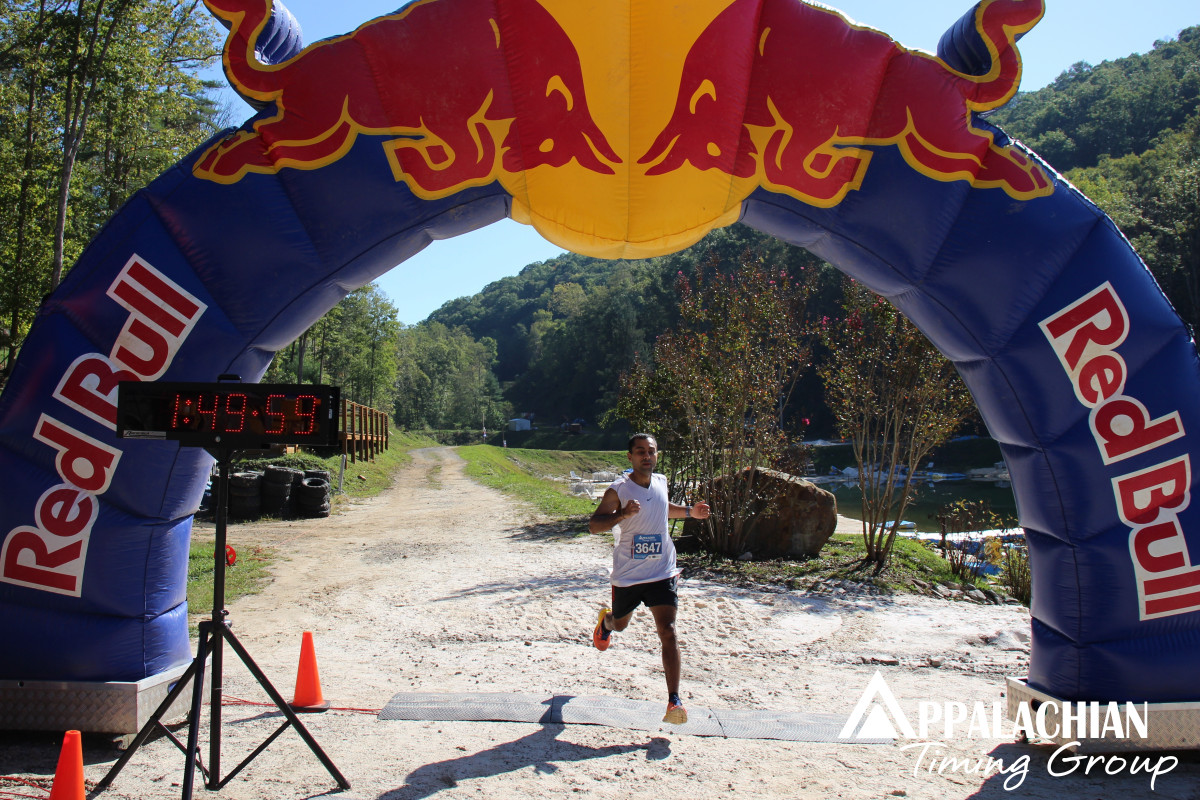
A trail race in West Virginia caught my attention: the New River Gorge Wilds Trail Run at ACE Adventure Resort.
I had several possible races that weekend, but this one offered something the others didn’t.
I had never raced a half marathon on a real trail.
That sounded interesting.
It also sounded like an excellent opportunity to discover several new forms of suffering.
I signed up.
My previous half marathons had at least given me a decent understanding of road racing. Trail racing immediately discarded much of that confidence.
The terrain demanded constant attention. Pace became much less meaningful. There were climbs, descents, uneven surfaces, and stretches where maintaining rhythm mattered less than simply finding the next good place to put a foot.
It was brutal.
It was also fantastic.
About halfway through, I took the energy gel I’d carried with me and became very thankful that Past Ritvik had possessed the foresight to bring it.
Eventually, after considerably more trail than my legs would have preferred, I reached the finish.
1:50:03.
That would have been much slower than my road half marathon PR.
It was also good enough for third overall.
That result reinforced something I’ve gradually learned about racing: a finishing time tells you very little without the course attached to it.
A 1:50 trail half can require far more from you than a much faster road race.
More importantly, I had finished my first trail half marathon and put West Virginia on the map.
I decided 13.1 miles was also approximately the maximum distance for which I wanted to make friends with that particular terrain.
For now.
4:38
Then came the mile.
The mile is a wonderfully unpleasant distance.
It’s too long to sprint and too short to settle in.
I had previously run exactly 5:00 while traveling. Since then, I’d lowered my PR further, but I wanted another shot.
On October 16, Orangetheory held the benchmark again.
For this attempt, I wore a relatively new pair of Nike Vaporfly 3s.
Carbon-plated racing shoes are peculiar things. They’re light, aggressive and slightly ridiculous, and the Vaporflys immediately felt much faster than my ordinary trainers.
Race strategy was simple enough.
Start fast.
Hold on.
Discover whether this was a mistake later.
I opened around 13 mph.
For the first several minutes, everything remained under control—or at least maintained a convincing appearance of being under control.
Then the usual negotiations began.
I dropped the pace slightly when my legs started objecting, tried several times to bring it back up, and saved whatever remained for the final stretch.
By then, the mile had ceased to be an athletic activity and become mostly an exercise in refusing to press the slower-speed button.
Finally, the treadmill crossed one mile.
4:38.
A nine-second PR.
And first on the studio leaderboard.
One comparison put the effort into perspective afterward: the pace I’d barely maintained for one mile was roughly in the neighborhood of the pace Eliud Kipchoge sustained during his famous sub-two-hour marathon exhibition.
I survived it for a little over four and a half minutes.
He continued for another twenty-five miles.
Running has a reliable way of making an achievement feel impressive and humbling at exactly the same time.
The Finish Line Keeps Moving
There were other milestones this year.
I ran about 120 treadmill miles during Orangetheory’s Marathon Month and finished first at my studio. I substantially improved my DriTri time. There were training runs, good workouts, terrible workouts, small PRs and probably several things I’ve already forgotten.
That’s part of why I wanted to write this.
Not because every workout needs to become a permanent artifact on the internet.
Most probably shouldn’t.
But some moments are worth marking.
My first half marathon.
My first destination half.
My first trail podium.
Four miles in Catch Me If You Can.
A 4:38 mile.
Individually, they’re just numbers and races.
Together, they tell me something more interesting: the ceiling keeps moving.
Every so often I reach a number that once seemed absurd, enjoy it briefly, and almost immediately wonder what the next one might be.
Perhaps that’s the real trick to crossing the finish line on top.
Enjoy the view.
Then find another starting line.
Comments